Rate this post

MCIA-Level-1 PDF Dumps Real 2022 Recently Updated Questions

Released MuleSoft MCIA-Level-1 Updated Questions PDF

NEW QUESTION 37
An external REST client periodically sends an array of records in a single POST request to a Mule application API endpoint.
The Mule application must validate each record of the request against a JSON schema before sending it to a downstream system in the same order that it was received in the array Record processing will take place inside a router or scope that calls a child flow. The child flow has its own error handling defined. Any validation or communication failures should not prevent further processing of the remaining records.
To best address these requirements what is the most idiomatic(used for it intended purpose) router or scope to used in the parent flow, and what type of error handler should be used in the child flow?


NEW QUESTION 38
What operation can be performed through a JMX agent enabled in a Mule application?


NEW QUESTION 39
A Mule application uses the Database connector.
What condition can the Mule application automatically adjust to or recover from without needing to restart or redeploy the Mule application?


NEW QUESTION 40
An organization has various integrations implemented as Mule applications. Some of these Mule applications are deployed to custom hosted Mule runtimes (on-premises) while others execute in the MuleSoft-hosted runtime plane (CloudHub). To perform the Integra functionality, these Mule applications connect to various backend systems, with multiple applications typically needing to access the backend systems.
How can the organization most effectively avoid creating duplicates in each Mule application of the credentials required to access the backend systems?


NEW QUESTION 41
An organization is creating a Mule application that will be deployed to CloudHub. The Mule application has a property named dbPassword that stores a database user’s password.
The organization’s security standards indicate that the dbPassword property must be hidden from every Anypoint Platform user after the value is set in the Runtime Manager Properties tab.
What configuration in the Mule application helps hide the dbPassword property value in Runtime Manager?


NEW QUESTION 42
An automation engineer needs to write scripts to automate the steps of the API lifecycle, including steps to create, publish, deploy and manage APIs and their implementations in Anypoint Platform.
What Anypoint Platform feature can be used to automate the execution of all these actions in scripts in the easiest way without needing to directly invoke the Anypoint Platform REST APIs?


NEW QUESTION 43
An integration Mule application is deployed to a customer-hosted multi-node Mule 4 runtime cluster. The Mule application uses a Listener operation of a JMS connector to receive incoming messages from a JMS queue.
How are the messages consumed by the Mule application?


NEW QUESTION 44
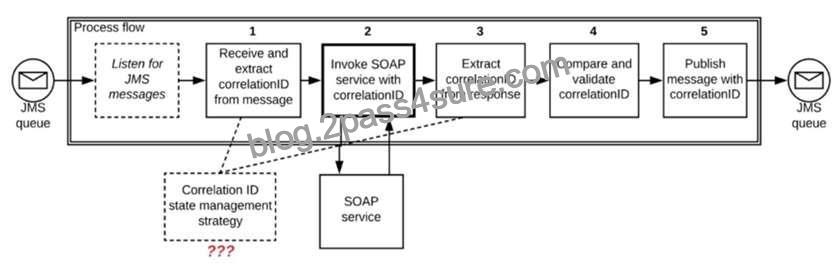
Refer to the exhibit. A Mule application is deployed to a multi-node Mule runtime cluster. The Mule application uses the competing consumer pattern among its cluster replicas to receive JMS messages from a JMS queue.
To process each received JMS message, the following steps are performed in a flow:
Step 1: The JMS Correlation ID header is read from the received JMS message.
Step 2: The Mule application invokes an idempotent SOAP webservice over HTTPS, passing the JMS Correlation ID as one parameter in the SOAP request.
Step 3: The response from the SOAP webservice also returns the same JMS Correlation ID.
Step 4: The JMS Correlation ID received from the SOAP webservice is validated to be identical to the JMS Correlation ID received in Step 1.
Step 5: The Mule application creates a response JMS message, setting the JMS Correlation ID message header to the validated JMS Correlation ID and publishes that message to a response JMS queue.
Where should the Mule application store the JMS Correlation ID values received in Step 1 and Step 3 so that the validation in Step 4 can be performed, while also making the overall Mule application highly available, fault- tolerant, performant, and maintainable?


NEW QUESTION 45
Refer to the exhibit.

This Mule application is deployed to multiple Cloudhub workers with persistent queue enabled. The retrievefile flow event source reads a CSV file from a remote SFTP server and then publishes each record in the CSV file to a VM queue. The processCustomerRecords flow’s VM Listner receives messages from the same VM queue and then processes each message separately.
How are messages routed to the cloudhub workers as messages are received by the VM Listener?


NEW QUESTION 46
Refer to the exhibit.


A business process involves two APIs that interact with each other asynchronously over HTTP. Each API is implemented as a Mule application. API 1 receives the initial HTTP request and invokes API 2 (in a fire and forget fashion) while API 2, upon completion of the processing, calls back into API l to notify about completion of the asynchronous process.
Each API Is deployed to multiple redundant Mule runtimes and a separate load balancer, and is deployed to a separate network zone.
In the network architecture, how must the firewall rules be configured to enable the above Interaction between API 1 and API 2?


NEW QUESTION 47
An Order microservice and a Fulfillment microservice are being designed to communicate with their dients through message-based integration (and NOT through API invocations).
The Order microservice publishes an Order message (a kind of command message) containing the details of an order to be fulfilled. The intention is that Order messages are only consumed by one Mute application, the Fulfillment microservice.
The Fulfilment microservice consumes Order messages, fulfills the order described therein, and then publishes an OrderFulfilted message (a kind of event message). Each OrderFulfilted message can be consumed by any interested Mule application, and the Order microservice is one such Mute application.
What is the most appropriate choice of message broker(s) and message destination(s) in this scenario?


NEW QUESTION 48
An organization’s security policies mandate complete control of the login credentials used to log in to Anypoint Platform.
What feature of Anypoint Platform should be used to meet this requirement?


NEW QUESTION 49
Refer to the exhibit.

A business process involves the receipt of a file from an external vendor over SFTP. The file needs to be parsed and its content processed, validated, and ultimately persisted to a database. The delivery mechanism is expected to change in the future as more vendors send similar files using other mechanisms such as file transfer or HTTP POST.
What is the most effective way to design for these requirements in order to minimize the impact of future change?


NEW QUESTION 50
A Mule application is being designed To receive nightly a CSV file containing millions of records from an external vendor over SFTP, The records from the file need to be validated, transformed. And then written to a database. Records can be inserted into the database in any order.
In this use case, what combination of Mule components provides the most effective and performant way to write these records to the database?


NEW QUESTION 51
Refer to the exhibit.

A Mule application is being designed to be deployed to several CIoudHub workers. The Mule application’s integration logic is to replicate changed Accounts from Satesforce to a backend system every 5 minutes.
A watermark will be used to only retrieve those Satesforce Accounts that have been modified since the last time the integration logic ran.
What is the most appropriate way to implement persistence for the watermark in order to support the required data replication integration logic?


NEW QUESTION 52
Anypoint Exchange is required to maintain the source code of some of the assets committed to it, such as Connectors, Templates, and API specifications.
What is the best way to use an organization’s source-code management (SCM) system in this context?


NEW QUESTION 53
Refer to the exhibit.

A Mule application is deployed to a cluster of two customer-hosted Mute runtimes. The Mute application has a flow that polls a database and another flow with an HTTP Listener.
HTTP clients send HTTP requests directly to individual cluster nodes.
What happens to database polling and HTTP request handling in the time after the primary (master) node of the cluster has railed, but before that node is restarted?


NEW QUESTION 54
An organization’s security policies mandate complete control of the login credentials used to log in to Anypoint Platform. What feature of Anypoint Platform should be used to meet this requirement?


NEW QUESTION 55
An API has been unit tested and is ready for integration testing. The API is governed by a Client ID Enforcement policy in all environments.
What must the testing team do before they can start integration testing the API in the Staging environment?


NEW QUESTION 56
What operation can be performed througha JMX agent enabled in a Mule application?


NEW QUESTION 57
Mule application is deployed to Customer Hosted Runtime. Asynchronous logging was implemented to improved throughput of the system. But it was observed over the period of time that few of the important exception log messages which were used to rollback transactions are not working as expected causing huge loss to the Organization. Organization wants to avoid these losses. Application also has constraints due to which they cant compromise on throughput much. What is the possible option in this case?


NEW QUESTION 58
To implement predictive maintenance on its machinery equipment, ACME Tractors has installed thousands of IoT sensors that will send data for each machinery asset as sequences of JMS messages, in near real-time, to a JMS queue named SENSOR_DATA on a JMS server. The Mule application contains a JMS Listener operation configured to receive incoming messages from the JMS servers SENSOR_DATA JMS queue. The Mule application persists each received JMS message, then sends a transformed version of the corresponding Mule event to the machinery equipment back-end systems.
The Mule application will be deployed to a multi-node, customer-hosted Mule runtime cluster. Under normal conditions, each JMS message should be processed exactly once.
How should the JMS Listener be configured to maximize performance and concurrent message processing of the JMS queue?


MCIA-Level-1 Dumps and Practice Test (132 Exam Questions): https://www.2pass4sure.com/MuleSoft-Certified-Architect/MCIA-Level-1-actual-exam-braindumps.html


Related Links: myportal.utt.edu.tt myportal.utt.edu.tt myportal.utt.edu.tt myportal.utt.edu.tt myportal.utt.edu.tt myportal.utt.edu.tt