NEW QUESTION 84
An administrator is configuring a DHCP server to better secure their environment. They need to be able to ratelimit the traffic and ensure that legitimate requests are not dropped. How would this be accomplished?
ExplanationTo understand DHCP snooping we need to learn about DHCP spoofing attack first.
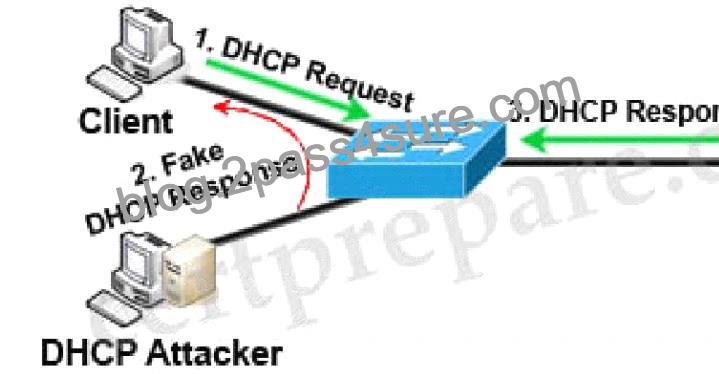
DHCP spoofing is a type of attack in that the attacker listens for DHCP Requests from clients and answers them with fake DHCP Response before the authorized DHCP Response comes to the clients. The fake DHCP Response often gives its IP address as the client default gateway -> all the traffic sent from the client will go through the attacker computer, the attacker becomes a “man-in-the-middle”.The attacker can have some ways to make sure its fake DHCP Response arrives first. In fact, if the attacker is “closer” than the DHCP Server then he doesn’t need to do anything. Or he can DoS the DHCP Server so that it can’t send the DHCP Response.DHCP snooping can prevent DHCP spoofing attacks. DHCP snooping is a Cisco Catalyst feature thatdetermines which switch ports can respond to DHCP requests. Ports are identified as trusted and untrusted.
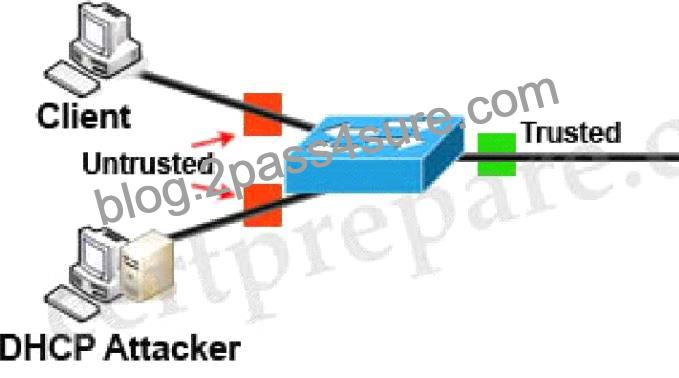
Only ports that connect to an authorized DHCP server are trusted, and allowed to send all types of DHCPmessages. All other ports on the switch are untrusted and can send only DHCP requests. If a DHCP responseis seen on an untrusted port, the port is shut down.
NEW QUESTION 85
What is the difference between a vulnerability and an exploit?
vulnerability is a flaw or gap in the security of a system or network that can be exploited by an attacker to compromise its functionality, integrity, confidentiality, or availability. A vulnerability can exist in the design, implementation, configuration, or operation of a system or network, and can be caused by human errors, software bugs, hardware defects, or environmental factors. A vulnerability can be exploited by an attacker using various methods, such as malware, phishing, brute force, denial-of-service, or injection attacks. A vulnerability can also be exploited by an insider who has legitimate access to the system or network, but abuses their privileges for malicious purposes. A vulnerability can be discovered by security researchers, ethical hackers, or malicious hackers, and can be reported to the vendor or the public for remediation or exploitation. A vulnerability can be mitigated by applying patches, updates, or configuration changes, or by using security tools such as firewalls, antivirus, or encryption.
An exploit is a piece of code, data, or technique that takes advantage of a vulnerability to perform unauthorized or malicious actions on a system or network. An exploit can be used to gain access, escalate privileges, execute commands, steal data, disrupt services, or damage resources. An exploit can be delivered by various means, such as email attachments, web links, removable media, or network packets. An exploit can be developed by security researchers, ethical hackers, or malicious hackers, and can be shared or sold on the dark web or other platforms for testing or attacking purposes. An exploit can be detected by security tools such as intrusion detection systems, antivirus, or anti-exploit software.
The difference between a vulnerability and an exploit is that a vulnerability is a potential weakness that can be exploited, while an exploit is an actual attack that uses a vulnerability. A vulnerability can exist without being exploited, but an exploit cannot exist without a vulnerability. A vulnerability can be fixed or prevented, but an exploit can only be blocked or stopped. References :=
* Exploit vs Vulnerability: What’s the Difference? – InfoSec Insights
* Difference Between Vulnerability and Exploit – GeeksforGeeks
* Exploit vs. Vulnerability: What Is the Difference? – Coralogix
* Exploit vs Vulnerability: What’s the Difference? – Cybers Guards
NEW QUESTION 86
An organization is implementing AAA for their users. They need to ensure that authorization is verified for every command that is being entered by the network administrator. Which protocol must be configured in order to provide this capability?
TACACS+ is a protocol that provides authentication, authorization, and accounting (AAA) services for network devices. Unlike RADIUS, which only supports authorization at the user level, TACACS+ supports authorization at the command level. This means that TACACS+ can verify the permissions of the network administrator for every command that is entered, and allow or deny access accordingly. This provides more granular and secure control over network resources and operations. EAPOL, SSH, and RADIUS are not protocols that can provide command-level authorization for AAA. References := Some possible references are:
* Implementing and Operating Cisco Security Core Technologies (SCOR) v1.0, Module 1: Security Concepts, Lesson 1.2: Network Security Devices and Cloud Services, Topic 1.2.3: AAA
* 350-701 SCOR – Cisco, Exam Topics, 1.0 Security Concepts, 1.2 Compare network security solutions,
1.2.a AAA
* What Is AAA Security? | Fortinet, Authentication, Authorization, and Accounting (AAA)
NEW QUESTION 90
What is a benefit of using telemetry over SNMP to configure new routers for monitoring purposes?
Explanation SNMP polling can often be in the order of 5-10 minutes, CLIs are unstructured and prone to change which can often break scripts. The traditional use of the pull model, where the client requests data from the network does not scale when what you want is near real-time data. Moreover, in some use cases, there is the need to be notified only when some data changes, like interfaces status, protocol neighbors change etc. Model-Driven Telemetry is a new approach for network monitoring in which data is streamed from network devices continuously using a push model and provides near real-time access to operational statistics. Referfence: https://developer.cisco.com/docs/ios-xe/#!streaming-telemetry-quick-start-guide/streaming telemetry SNMP polling can often be in the order of 5-10 minutes, CLIs are unstructured and prone to change which can often break scripts.
The traditional use of the pull model, where the client requests data from the network does not scale when what you want is near real-time data.
Moreover, in some use cases, there is the need to be notified only when some data changes, like interfaces status, protocol neighbors change etc.
Explanation SNMP polling can often be in the order of 5-10 minutes, CLIs are unstructured and prone to change which can often break scripts. The traditional use of the pull model, where the client requests data from the network does not scale when what you want is near real-time data. Moreover, in some use cases, there is the need to be notified only when some data changes, like interfaces status, protocol neighbors change etc. Model-Driven Telemetry is a new approach for network monitoring in which data is streamed from network devices continuously using a push model and provides near real-time access to operational statistics. Referfence: https://developer.cisco.com/docs/ios-xe/#!streaming-telemetry-quick-start-guide/streaming telemetry
NEW QUESTION 93
A network administrator is configuring a role in an access control policy to block certain URLs and selects the
“Chat and instant Messaging” category. which reputation score should be selected to accomplish this goal?
To block certain URLs based on the “Chat and Instant Messaging” category, the network administrator should select a reputation score of 5. A reputation score is a numerical value that indicates the likelihood of a URL being malicious or unwanted. The lower the score, the higher the risk. A score of 5 means that the URL is suspicious or potentially harmful, and should be blocked or inspected12. A score of 3 means that the URL is unknown or unverified, and may be allowed or blocked depending on the policy settings12. A score of 10 means that the URL is trustworthy or benign, and should be allowed12. A score of 1 means that the URL is malicious or high-risk, and should be blocked12. Therefore, a score of 5 is the most appropriate to block the
“Chat and Instant Messaging” category, which may contain unwanted or problematic websites. References:
* Reputation score, section “Reputation score”.
* Web content filtering, section “What is web content filtering?”.